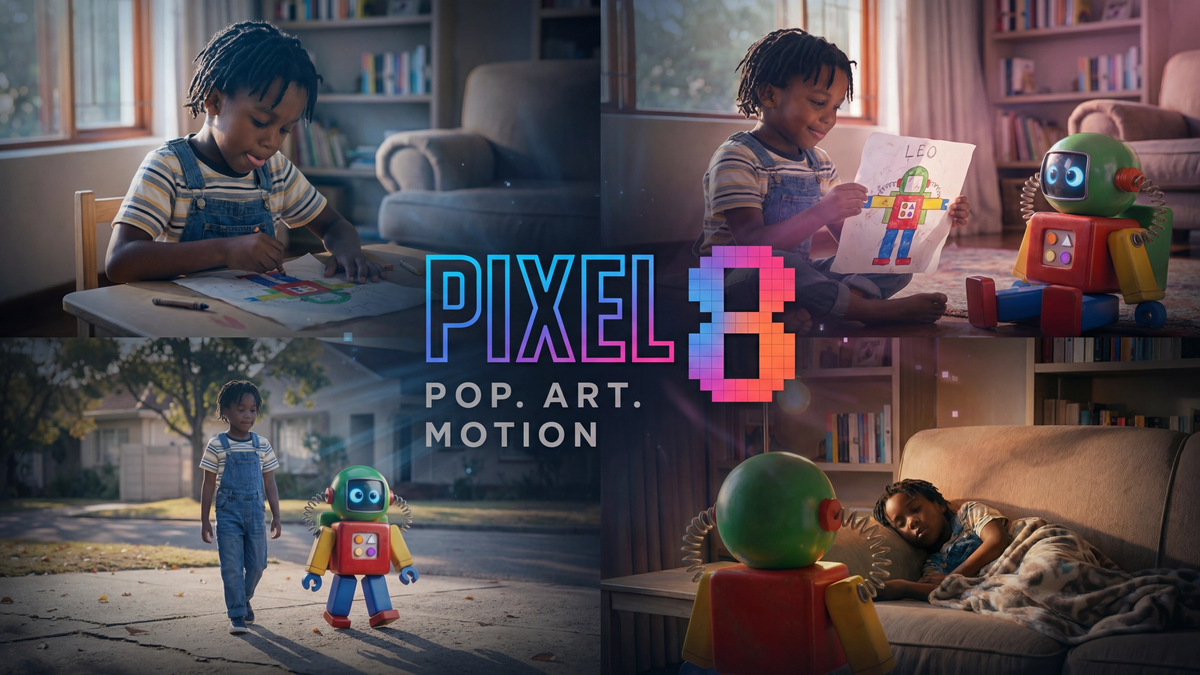
Every parent has the same problem: your kid produces a drawing that genuinely floors you, you stick it on the fridge, and six weeks later it's curled up at the corners and your toddler has drawn over the best bit with a Sharpie. Crayon To Creation is our answer to that — we take the original drawing and transform it into a fully realised 3D character in its own cinematic scene, ready to live on the wall as a print, sit in your inbox as a digital still, or move as a 30-second animated short.
It's also the service we get the most thank-yous about from grandparents at Christmas. Here's how it works.
Step 1: Send us the drawing
A phone photo is fine. Take it in good daylight, flat against a table, no shadow falling across the paper. If you've got a flatbed scanner, even better, but honestly a decent phone shot from the last five years works perfectly. Shoot straight down from above and get as close as you can while keeping the whole drawing in frame.
Tell us anything we should know about the drawing. The character on the left is the family dog. The thing in the corner is supposed to be a spaceship. The yellow blob in the sky is Grandma. We need this — the whole point is to honour what the kid intended. If you have more than one drawing of the same character, mention it; extra reference helps us understand the personality.
You can also, if you'd like, send us photos of your child. That unlocks the option to place them right there in the scene alongside their creation — the moment of imagination meeting reality. It's optional, but it's one of the most popular choices parents make.
Step 2: We build the 3D character and scene
This is the part that takes the longest. We take the drawing and transform it into a cinematic 3D character, keeping the personality, colour choices and structural quirks of the kid's version intact, then place that character in its own scene rendered with professional production quality.
The charm of the original artistic decisions is the whole point — a six-legged dog stays a six-legged dog. What changes is the execution: a flat crayon sketch becomes a character with depth, lighting and a world around it. If you've sent photos of your child, this is the stage where we composite them into the scene with their character.
Step 3: Choose how you want it delivered
Crayon To Creation comes in three forms, and you choose at the point of ordering.
Digital still — £19.99. The 3D character and scene delivered as a digital file. This is the base of every commission.
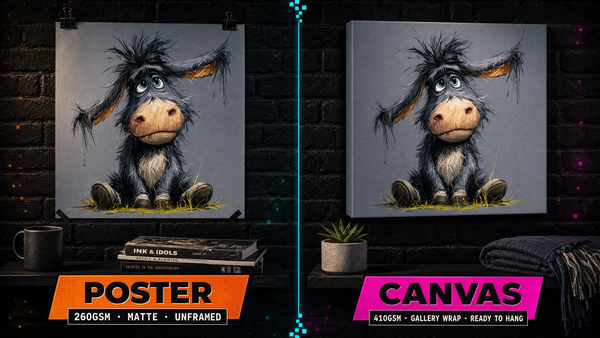
Prints. Add a physical version in any of our three formats — Poster Print, Canvas Standard, or Canvas Gallery. A single print starts from £29.98; a bundle of two or more starts from £39.97, with one artwork fee across the whole order so every extra print is cheaper. For kids' rooms we usually recommend Canvas Standard — no glass to break, no frame to mount, ready to hang the day it arrives.
Animated short. This is the part the fridge could never do. We add subtle cinematic motion to the character and scene over 30 seconds — gentle character animation, camera moves, environmental effects like light shifts and atmosphere. Two options: Animation with music (£79.99) or Animation with music and an AI-generated voiceover (£99.99). Both include the digital still.
A quick, honest note on the animation. It's designed to be a magical 30-second short, not a Pixar feature. It brings the character to life in its own world beautifully. What it can't do is lip-sync a voiceover to the character's mouth, stage complex multi-character action, or deliver feature-film choreography. If you choose the voiceover option, the script runs to around 80 words for 30 seconds — you can write it yourself or leave it to us, and you pick the voice and accent or let us choose. Soundtracks are custom-generated to your chosen mood; we can't use a specific copyrighted song.
Step 4: We make it and send it to you
We build your character and scene, then send you the finished piece — a secure download link for the digital still and any animation, with prints posted out separately if you ordered them. Everything's made to order and crafted with care to honour the original drawing, so what arrives is the finished article: ready for the wall, the inbox, or the TV on Christmas morning.
Which drawings work best
Almost any drawing translates well — pencil, crayon, pen, paint, finger-painting. The ones that come out best tend to have a clear central subject (a person, an animal, a vehicle, a house), use a decent number of colours rather than a single-colour pencil sketch, and fill most of the page. Tiny drawings in the corner of an A4 page can be scaled up, but you lose some of the personality.
Drawings from kids aged 3-9 hit the sweet spot. Older than that and kids start trying to draw realistically, which is less interesting to elevate. Younger and you sometimes get drawings that are too abstract to read as a recognisable subject — though we've still made beautiful pieces from those.
Who buys it
Parents, obviously — usually as a permanent record of a phase that's about to end. Grandparents, often as a Christmas or birthday gift for their grandchild and a copy for their own wall. Aunts and uncles, less often but always with thought. And occasionally adults commissioning it of their own childhood drawings, which is one of our favourite versions of the brief.
The digital still and prints suit people who want a keepsake on the wall. The animated short tends to be chosen for bigger occasions — a milestone birthday, a gift that gets played on the TV on Christmas morning.
What it costs and how long it takes
Pricing is fixed and shown up front: £19.99 for the digital still, prints from £29.98, animation from £79.99. Crayon To Creation is one of our quicker commissions — the digital still and prints usually turn around within 7-10 working days from when we receive the source drawing. Animated shorts take a little longer.
Ready to commission one? Head to the Crayon To Creation service page, upload a photo of the drawing, and choose your delivery option. If you're not sure whether your kid's drawing will work, send it anyway — we'll tell you honestly, and we'll usually be more enthusiastic than you expect.